CPDDNet: Color-Polarization Denoising and Demosaicking Network
Qihang Zhang1,2,
Yusuke Monno1,
Masayuki Tanaka1,
and Masatoshi Okutomi1
1Institute of Science Tokyo 2The Chinese University of Hong Kong, Shenzhen
IEEE International Conference on Image Processing 2026
Project Summary
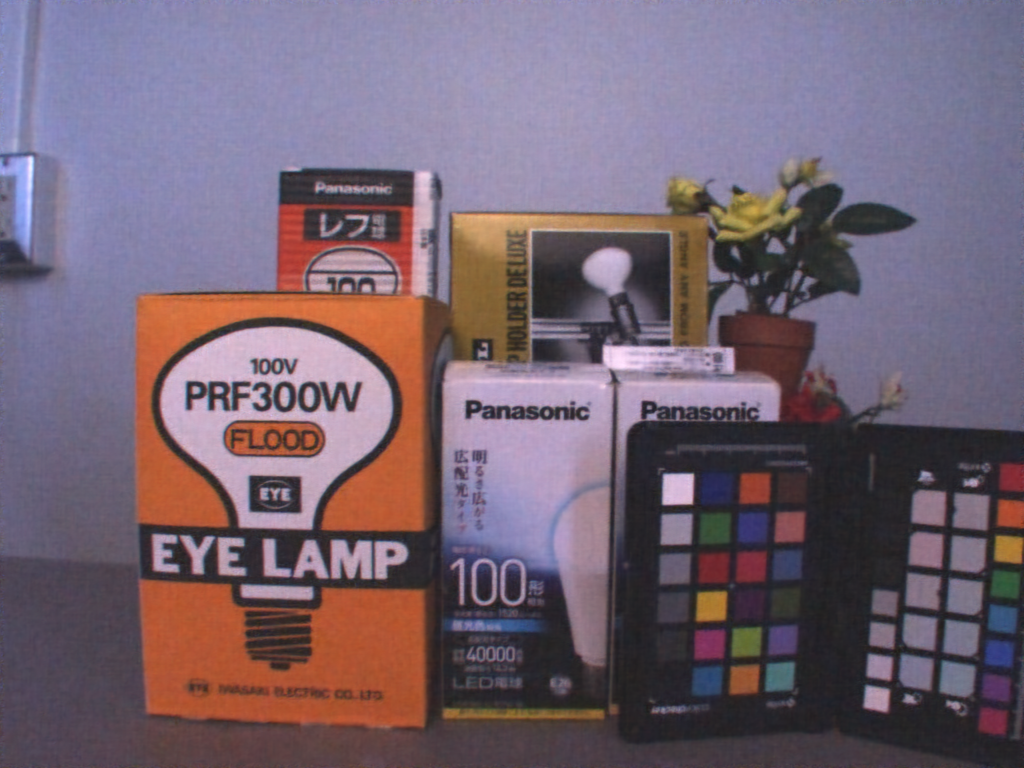
Color-polarization filter array (CPFA) sensors capture color texture and polarization information in a single shot. In this project, we aim at developing a high-quality denoising and demosaicking method for color-polarization cameras.
Paper Abstract
Color-polarization filter array (CPFA) sensors capture color texture and polarization information in a single shot, but the raw mosaic data suffer from both noise and missing samples. Existing pipelines usually solve denoising (DN) and demosaicking (DM) separately, which can propagate noise or oversmooth structures needed for polarization recovery. In this work, we propose CPDDNet, a color-polarization denoising and demosaicking network for CPFA sensors. CPDDNet follows a DN-to-DM design and introduces a feature fusion module to retain raw CPFA information through both stages. This improves reconstructed color-polarization images and polarization parameters under severe noise. Experiments show that CPDDNet outperforms existing DM-only, DM-to-DN, and DN-to-DM methods on a high-noise color-polarization dataset.
Our Method Overview
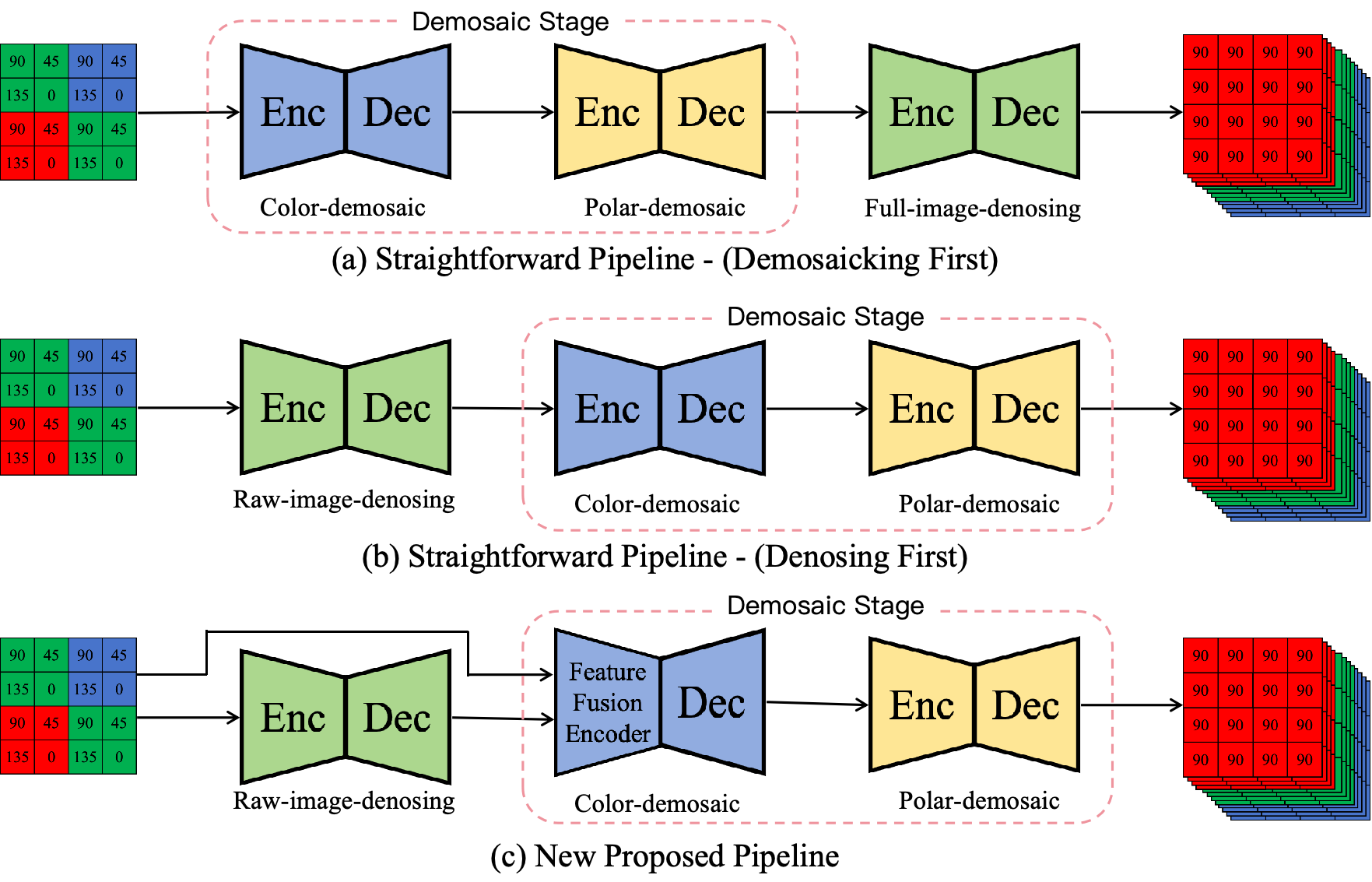
The overviews of different pipelines. The straightforward pipelines sequentially apply demosaicking (DM) and denoising (DN) as DM-to-DN (a) or DN-to-DM (b). While our proposed pipeline (c) is based on the DN-to-DM pipeline, we newly introduce a feature fusion encoder to retain the information from the raw CPFA data at both the DN and the DM stages, reducing the information loss in the whole pipeline
Download Materials
Interactive Visual Comparison
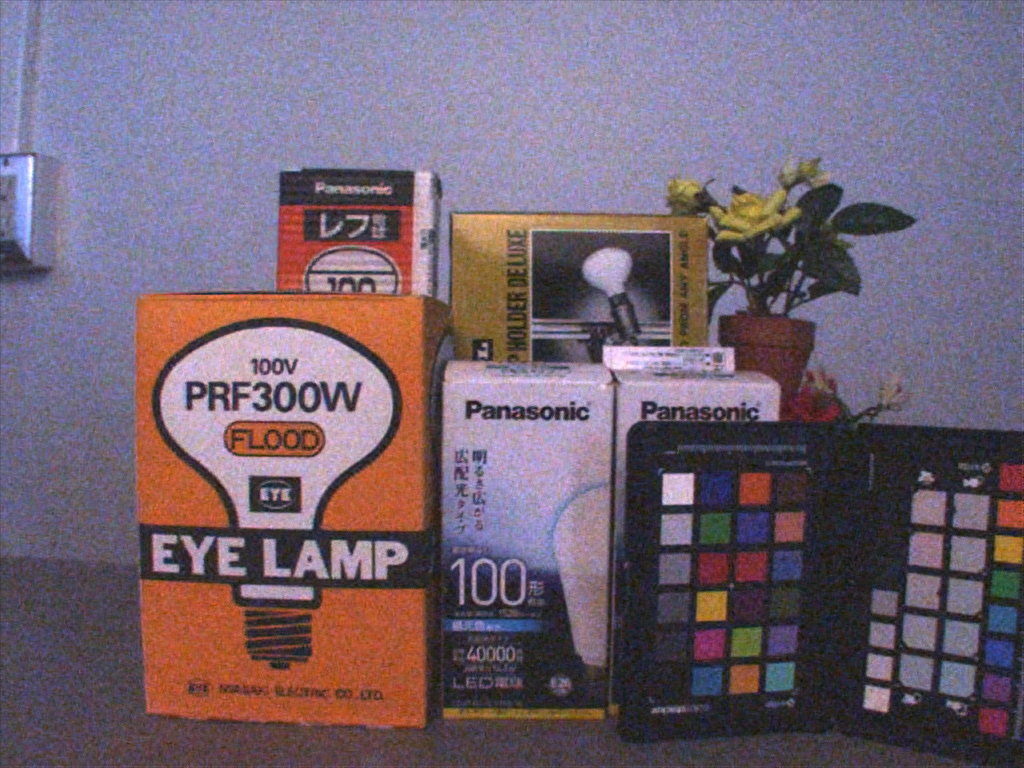
Select a scene, polarization angle or AoP-DoP view, and the image shown on the left side of the slider. The right side is fixed to CPDDNet. The AoP-DoP view uses G-channel data. The colorization standard for AoP-DoP images can be found in Fig. 4 of the paper.
Publication
- CPDDNet: Color-Polarization Denoising and Demosaicking Network
- Qihang Zhang, Yusuke Monno, Masayuki Tanaka, and Masatoshi Okutomi
- IEEE International Conference on Image Processing (ICIP), 2026.