Virtual Chromoendscopy with
Tunable Visibility Enhancement

Yuhi Kanno1, Yusuke Monno1, Sho Suzuki2, Tomohiro Tada3, Masatoshi Okutomi1

1 Institute of Science Tokyo
2 International University of Health and Welfare Ichikawa Hospital
3 AI Medical Service Inc.

Project Overview

In this work, we proposed Virtual Enhanced Chromoendoscopy (V-ECE), which combines Virtual Chromoendoscopy (V-CE) with image enhancement techniques. This should help clinicians to find lesions, such as early cancer. Also, we proposed a novel image translation model to achieve enhancement levels tunable at inference-time. This Tunable Virtual Enhanced Chromoendoscopy (TV-ECE) can therefore be introduced for various inspected lesions or various clinicians' preferences. Experimental results show that our proposed model can plausibly generate V-ECE images with various enhancement levels despite a unified model.

Method Overview
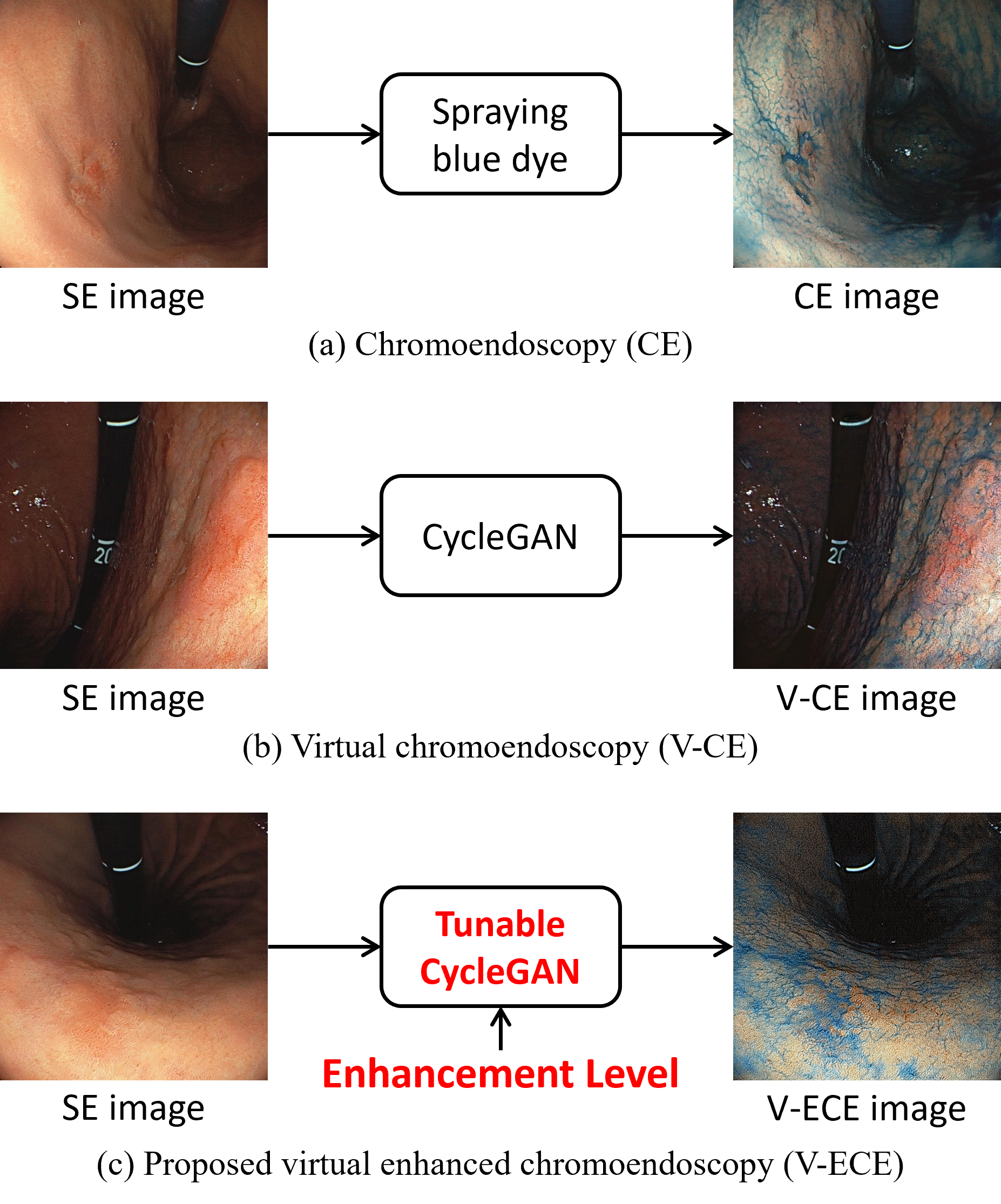
Comparison of chromoendoscopy techniques
Fig. 1 — Comparison of chromoendoscopy techniques. (a) is the standard chromoendoscopy technique, which involves spraying a blue dye on the gastric surface. (b) and (c) are the virtual chromoendoscopy techniques, which apply a learned image translation model to the Standard Endoscope (SE) images. (c) is the proposed methodology, which can generate enhanced images with the user's input gain.
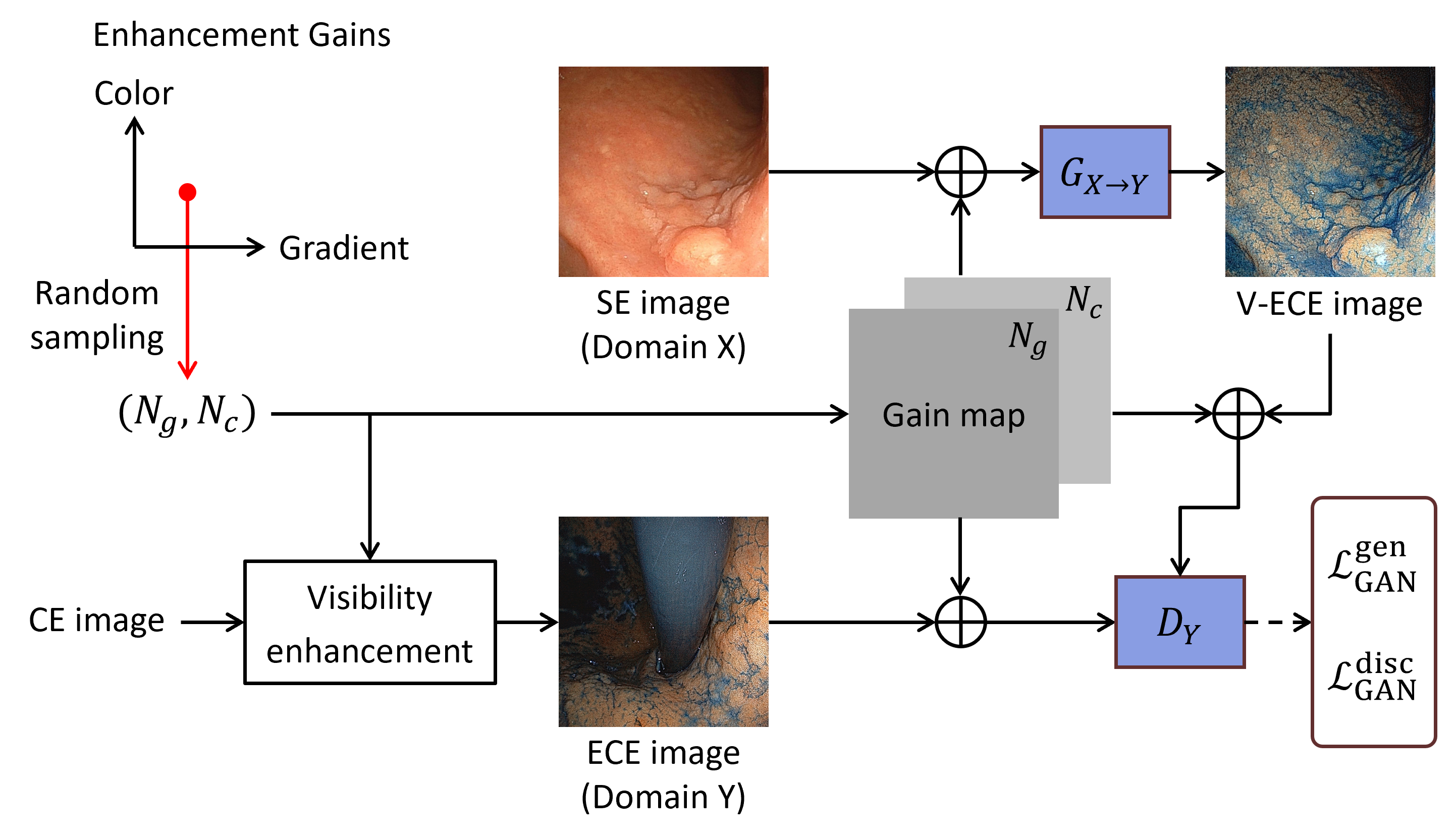
Training-time architecture of the proposed model
Fig. 2 — Training-time of TV-ECE. The gradient and the color gains are randomly sampled from certain ranges and concatenated as the inputs to the generator and the discriminator. The generator tries to generate V-ECE images with the corresponding gains, while the discriminator tries to discriminate them from real Enhanced Chromoendoscopy (ECE) images enhanced using the same gains. By this architecture, the discriminator identifies not only whether the ECE image is real or not, but also whether the enhancement level is correct or not, directing the generator to generate the V-ECE images with the correct enhancement level.
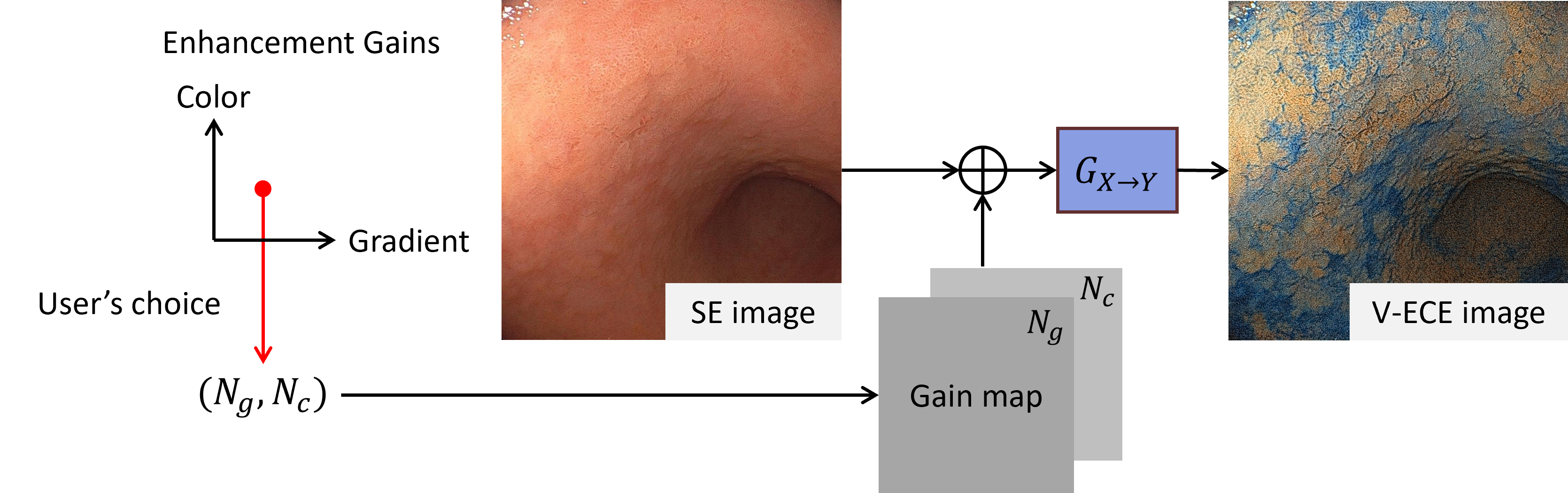
Inference-time pipeline of TV-ECE
Fig. 3 — Inference-time of TV-ECE. TV-ECE accepts the Standard Endoscope (SE) images and the user's preference gain to output translated V-ECE images with desired gain. This process can be done in real-time.

Results

Video 1 — Tunable V-ECE translation. Standard Endoscope (SE) video input translated to V-ECE video while varying the enhancement gains with our unified model.
Video 2 — Continuous enhancement sweep. Additional result showing the V-ECE output as the enhancement level is swept across its range. The results show that TV-ECE model can reflect each gain.

Publications

  1. Virtual Chromoendscopy with Tunable Visibility Enhancement
    Yuhi Kanno, Yusuke Monno, Sho Suzuki, Tomohiro Tada, Masatoshi Okutomi
    48th Annual International Conference of the IEEE Engineering in Medicine and Biology Society (EMBC 2026) Paper link