BESegNet: A Bone Erosion Segmentation Network for Rheumatoid Arthritis in Conventional Radiography
Songxiao Yang1,
Haolin Wang2,
Tamotsu Kamishima3,
Masayuki Ikebe4,
Yafei Ou4 and
Masatoshi Okutomi1
1Institute of Science Tokyo, Tokyo, Japan
2Graduate School of Health Sciences, Hokkaido University, Sapporo, Japan
3Faculty of Health Sciences, Hokkaido University, Sapporo, Japan
4Research Center for Integrated Quantum Electronics, Hokkaido University, Sapporo, Japan
IEEE EMBC 2026
Abstract
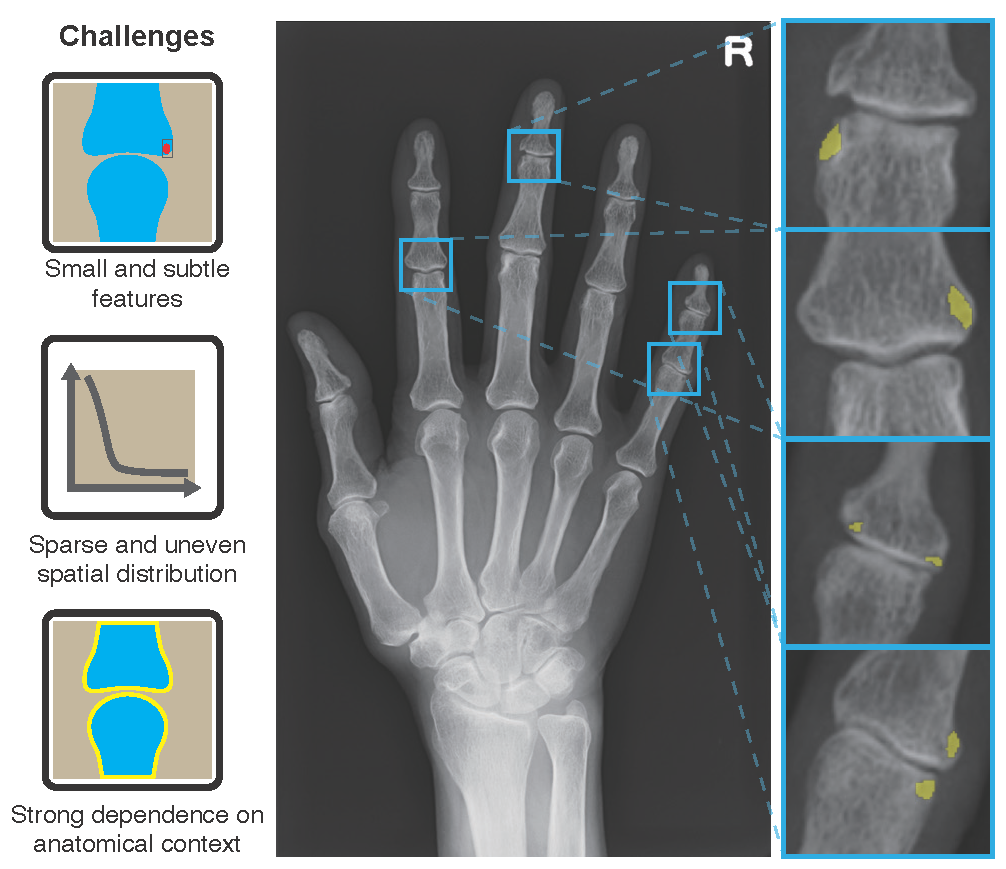
Bone erosion (BE) is a key imaging biomarker for disease assessment in rheumatoid arthritis (RA), yet reliable analysis from conventional radiographs remains highly challenging due to the small size, sparse distribution, subtle appearance of erosive lesions, and their strong dependence on anatomical context. In this study, we formulate BE analysis as a fine-grained pixel-wise segmentation problem and propose BESegNet, the first segmentation framework specifically designed for BE delineation in full-hand conventional radiographs. The proposed framework adopts a patch-based design and integrates spatial and anatomical information by jointly modeling positional context and bone cortex proximity, which are adaptively fused with appearance features through an anatomy-aware gating mechanism. Extensive experiments on a multi-institutional hand radiograph dataset demonstrate that the proposed framework consistently outperforms state-of-the-art methods across multiple evaluation metrics. The proposed framework enables objective and anatomically consistent BE delineation, providing a reliable foundation for quantitative RA assessment and improved sensitivity to early erosive changes.
Challenge
Overview
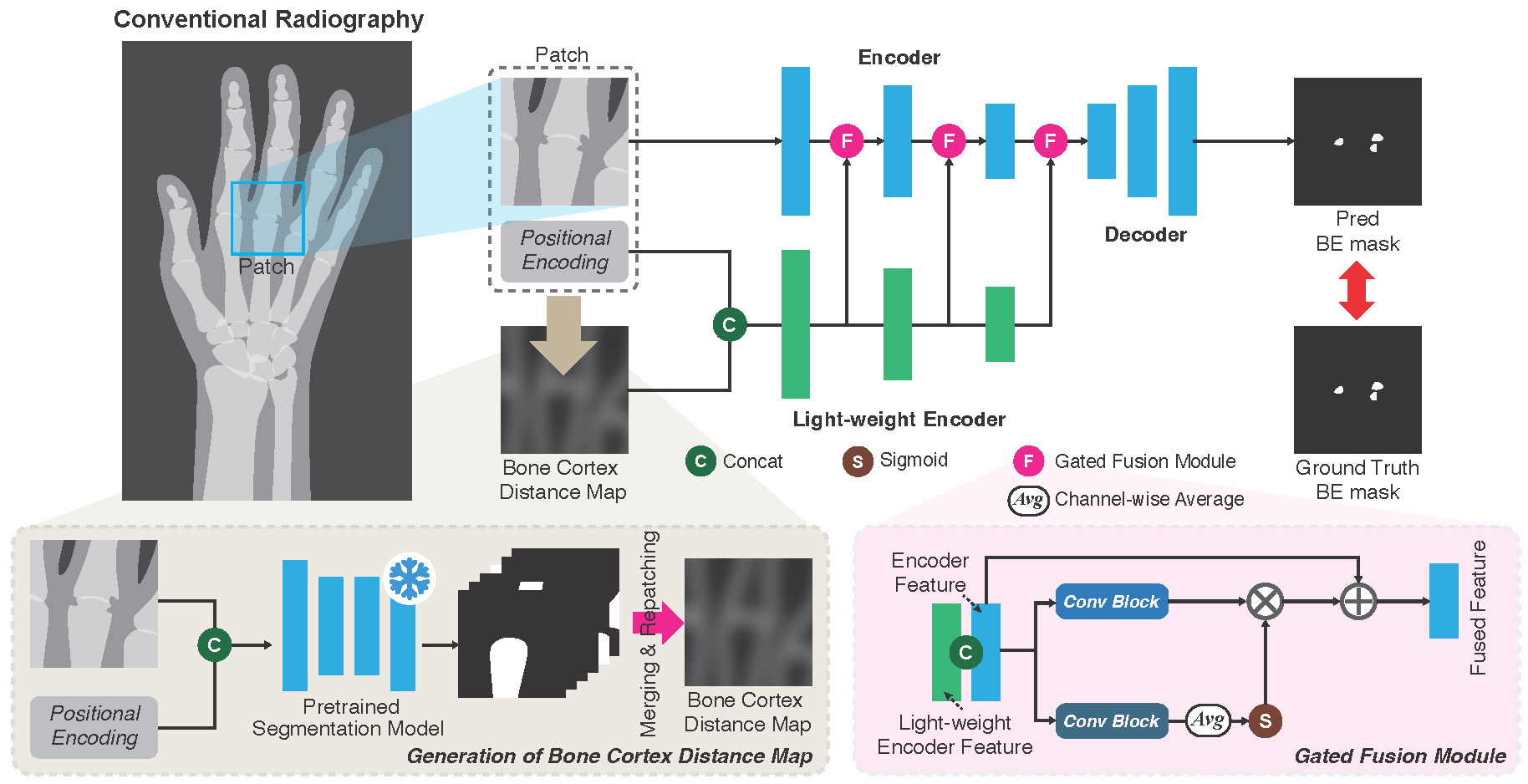
BESegNet processes high-resolution hand radiographs in a patch-wise manner to address the small size, sparse distribution, and strong anatomical dependence of BE regions. Positional encoding preserves spatial context, while a pretrained bone segmentation model estimates a bone cortex distance map that provides anatomical proximity information. This prior is fused with image features through a lightweight encoder and gated fusion modules in the decoder, producing anatomically informed BE predictions that are merged into a full-resolution mask.
Dataset
The study uses 470 hand posteroanterior projection radiographs from 56 patients with RA and 50 patients without RA. Images were collected from three institutions: Hokkaido Medical Center for Rheumatic Diseases, Sapporo City General Hospital, and Hokkaido University. Bone instance masks and BE annotations were created through a collaborative annotation process with trained medical assistants and physicians, then reviewed and verified by an experienced radiologist.
Benchmark Results
BESegNet consistently improves BE segmentation over state-of-the-art segmentation models. With a SwinUMamba backbone, BESegNet achieves the best DSC, NSD, F1, and VOE among the compared methods, demonstrating the benefit of combining positional encoding, bone cortex distance maps, and anatomy-aware gated fusion.
| Model | DSC (%) | NSD (%) | PREC (%) | REC (%) | F1 (%) | VOE (%) | MSD | RAVD |
|---|---|---|---|---|---|---|---|---|
| UNet | 21.27 | 18.26 | 13.06 | 23.42 | 14.68 | 87.13 | 160.94 | 1.71 |
| SwinUMamba | 22.36 | 19.55 | 16.48 | 20.06 | 15.44 | 86.40 | 160.38 | 0.91 |
| BESegNet (UNet) | 23.14 | 20.65 | 19.12 | 20.34 | 15.98 | 85.62 | 129.44 | 0.99 |
| BESegNet (SwinUMamba) | 24.95 | 20.78 | 19.08 | 22.72 | 17.22 | 84.72 | 135.13 | 1.04 |
Publication
BESegNet: A Bone Erosion Segmentation Network for Rheumatoid Arthritis in Conventional Radiography
Songxiao Yang, Haolin Wang, Tamotsu Kamishima, Masayuki Ikebe, Yafei Ou and Masatoshi Okutomi
IEEE EMBC 2026
@inproceedings{yang2026besegnet,
  author = {Yang, Songxiao and Wang, Haolin and Kamishima, Tamotsu and Ikebe, Masayuki and Ou, Yafei and Okutomi, Masatoshi},
  title = {{BESegNet: A Bone Erosion Segmentation Network for Rheumatoid Arthritis in Conventional Radiography}},
  booktitle = {Proceedings of the IEEE Engineering in Medicine and Biology Conference (EMBC)},
  year = {2026}
}