Recent advances in 3D Gaussian Splatting (3DGS) have enabled high-quality, render-ready scene representations for novel-view synthesis. However, most existing 3DGS pipelines rely on multi-view observations (or non-causal access to future frames) to achieve sufficient coverage, which is often unavailable in on-device robotics and AR settings where sensing is restricted to a single stereo rig. Recovering a high-quality 3DGS scene from one stereo observation, therefore, remains challenging due to occlusions, limited field of view, and missing geometry.
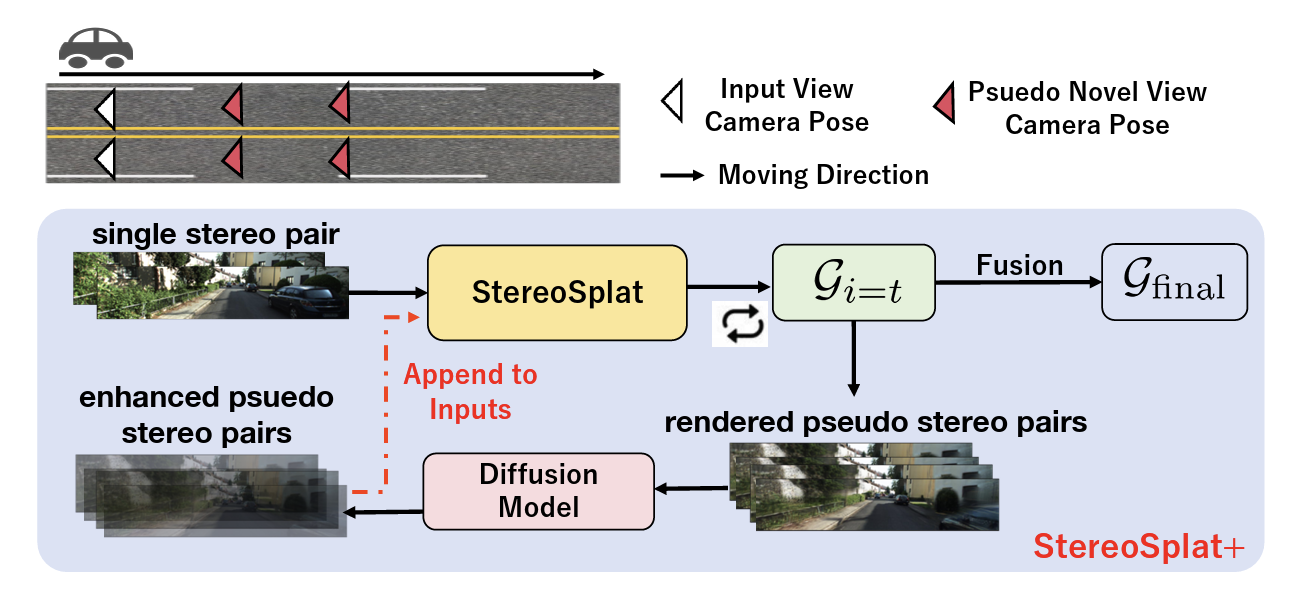
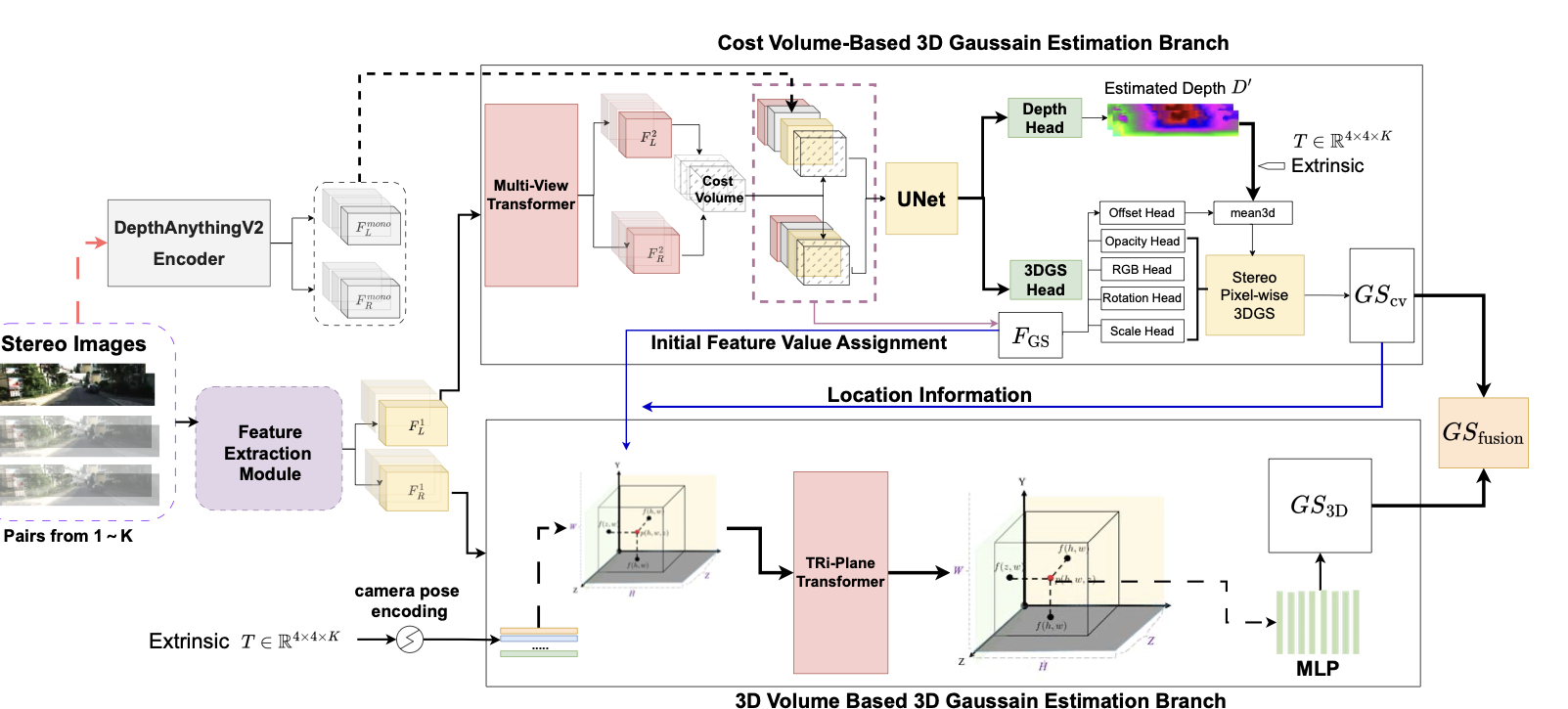
We present StereoSplat+, a diffusion-enhanced feed-forward framework that enables causal reconstruction from a single stereo pair. Our method builds on two key components. First, we propose StereoSplat, an input-invariant feed-forward 3D Gaussian estimator that takes a variable number of posed stereo pairs as input and predicts high-quality 3D Gaussians. StereoSplat fuses complementary geometry cues via a cost-volume branch and a triplane-based 3D volume branch, and leverages continuous pose encoding to generalize across view counts and camera configurations. Second, since multiple posed stereo pairs are typically unavailable at inference time, we introduce a diffusion-enhanced one-shot progressive inference scheme called StereoSplat+: starting from one stereo pair, we render novel stereo views from the predicted 3DGS, refine them with a one-step diffusion enhancer, and feed them back as additional inputs to update the 3DGS.
Experiments on the KITTI-360 dataset show that StereoSplat+ improves novel-view rendering quality and geometry accuracy, especially in occluded regions and under strong view extrapolation, outperforming recent feed-forward 3DGS baselines.
Given a single stereo pair, StereoSplat+ first estimates an initial 3D Gaussian scene, renders pseudo novel stereo views, enhances them with a one-step diffusion model, and re-injects the enhanced views as additional inputs. The final scene representation is obtained via confidence-guided fusion.
StereoSplat adopts a dual-branch design. The cost-volume branch preserves metric stereo cues, while the triplane Transformer branch aggregates geometric evidence in 3D space. The two branches are coupled via feature-value assignment guided by Gaussian locations estimated by the cost-volume branch, yielding a fused 3D Gaussian representation for novel-view synthesis.
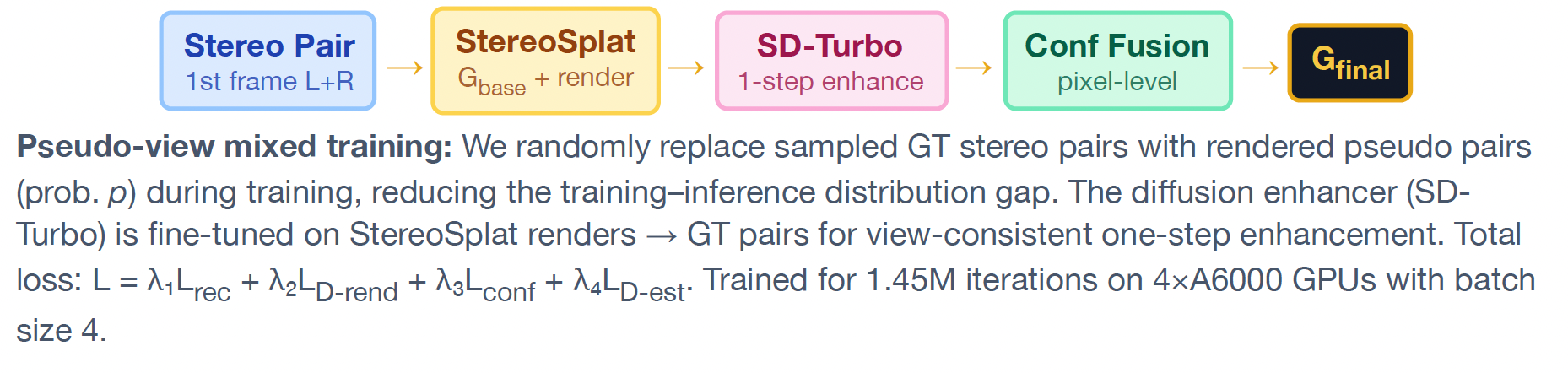
Starting from a single stereo pair, we estimate an initial 3DGS (Gbase), render pseudo views, refine them with a one-step SD-Turbo enhancer, and fuse the results via confidence-guided fusion to obtain the final representation Gfinal.
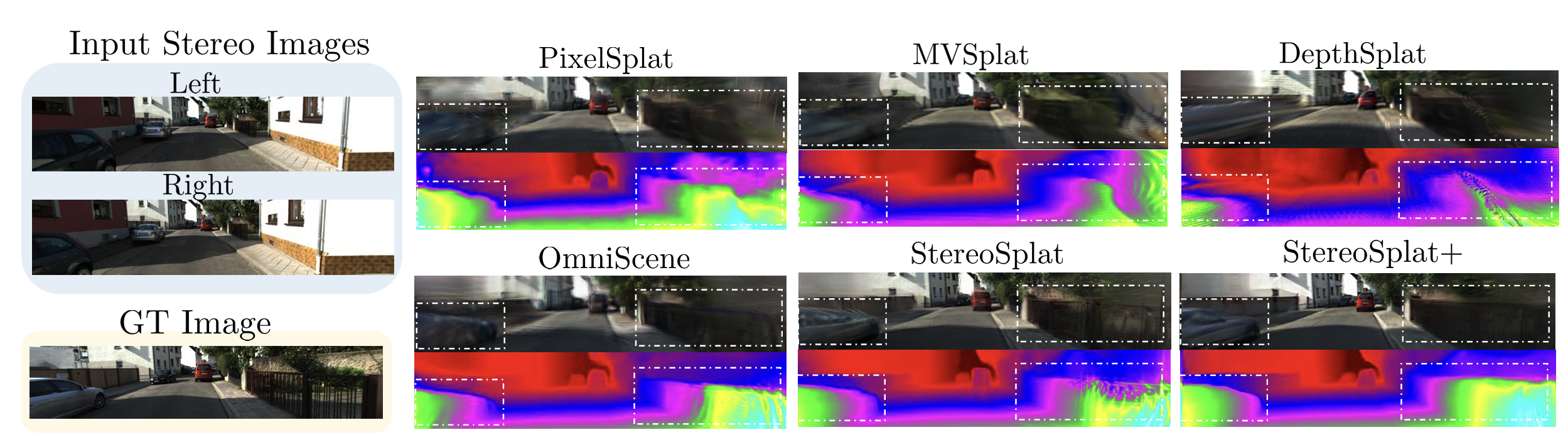
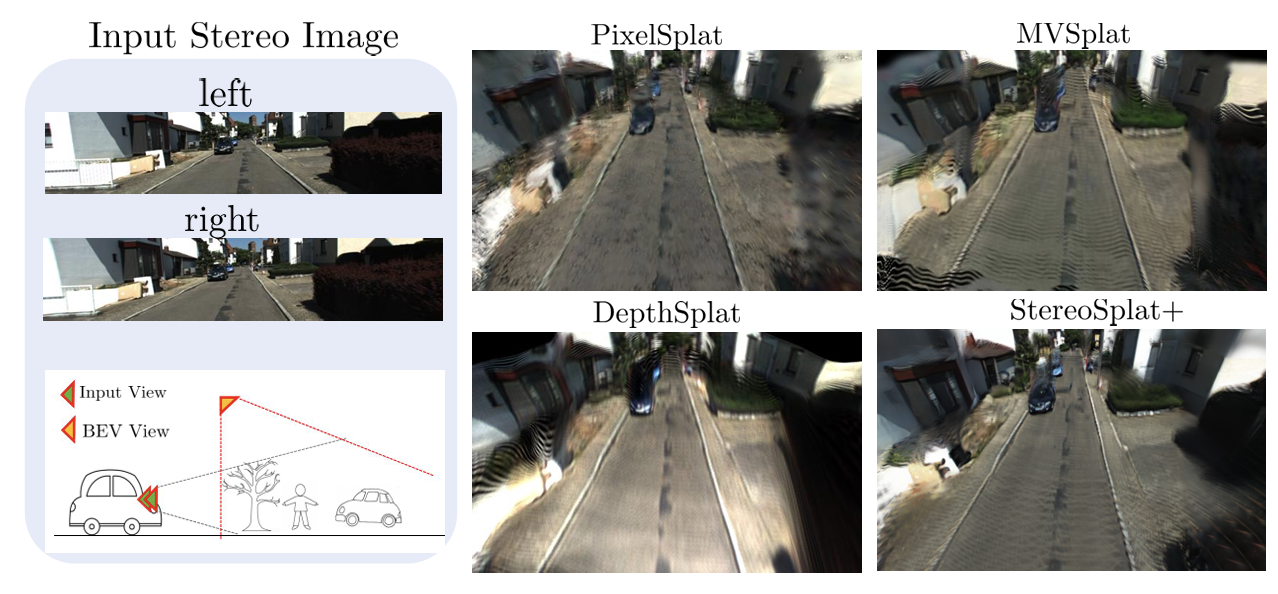
Compared with existing feed-forward methods that rely only on a single stereo image pair as input, StereoSplat+ recovers significantly better novel views, not only for interpolation between nearby viewpoints, but also for more challenging extrapolated viewpoints, such as bird's-eye-view observations.
We compare against recent feed-forward 3D Gaussian baselines on KITTI-360 using only the first-frame stereo pair as input. Results are averaged over all frames within each bin.
| Method | PSNR ↑ | SSIM ↑ | AbsRel ↓ | SqRel ↓ |
|---|---|---|---|---|
| PixelSplat | 19.04 | 0.60 | 0.094 | 0.579 |
| MVSplat | 18.69 | 0.53 | 0.098 | 0.619 |
| OmniScene | 18.19 | 0.53 | 0.117 | 0.657 |
| DepthSplat | 18.60 | 0.60 | 0.140 | 0.767 |
| StereoSplat (Ours) | 20.42 | 0.67 | 0.071 | 0.386 |
| StereoSplat+ (Ours) | 20.76 | 0.69 | 0.096 | 0.487 |
Table II: Comparison of feed-forward 3D Gaussian methods on KITTI-360 using a single stereo pair (first frame) as input. Best is in red; second-best is in bold.
Existing feed-forward 3D Gaussian methods struggle to reconstruct stable and geometrically consistent scenes from only the first-frame stereo pair, exhibiting motion blur, ghosting, and over-smoothed depth. StereoSplat+ produces sharper RGB renderings, more coherent depth, and suppresses floaters and ringing artifacts.
Extrapolating from the first-frame stereo pair to a distant bird's-eye view is highly challenging. Baseline methods suffer from severe ripple artifacts and distorted road/building geometry, whereas StereoSplat+ yields a much cleaner BEV rendering with straighter lane markings and more stable building structures.
Our work builds upon recent feed-forward 3D Gaussian Splatting methods such as PixelSplat, MVSplat, and DepthSplat, as well as diffusion-assisted 3DGS approaches that refine rendered views for improved geometry.
Compared with these methods, StereoSplat+ is tailored to stereo-only, causal settings common in robotics and autonomous driving, where only a single rectified stereo pair is available at inference time.
@inproceedings{liu2026stereosplatplus,
  author    = {Liu, Zihua and Okutomi, Masatoshi},
  title     = {StereoSplat+: Feed-Forward Stereo Gaussian Splatting with Diffusion-Assisted Progressive Inference},
  booktitle = {IEEE/RSJ International Conference on Intelligent Robots and Systems (IROS)},
  year      = {2026},
}